| September 21, 2026 | Comments Closed |
What Is the Difference Between Automatic and Manual Driving Lessons?
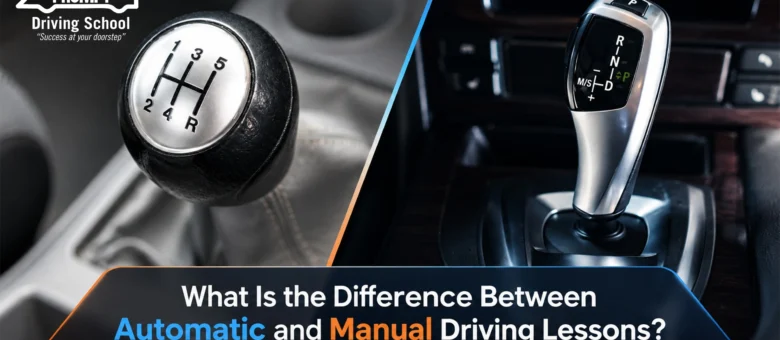
Every learner eventually asks whether to start with an automatic car or a manual one. Automatic cars skip the clutch pedal and gear stick altogether. Manual cars ask you to manage both, along with steering and braking.
This one decision shapes your comfort, your learning pace, and your future driving flexibility. Automatic vs Manual Driving Lessons differ in controls, difficulty, confidence building, licence rules, and long-term flexibility, though either path can still make you a safe, capable driver.
What Are Automatic Driving Lessons?
Automatic driving lessons focus on a car that shifts gears on its own. That leaves learners free to focus on reading the road from the very first session.
-
How an Automatic Car Works
There’s no clutch pedal in an automatic car, so gear changes never fall on the driver. Lessons instead centre on steering, braking, acceleration, observation, and road positioning.
-
Who May Prefer Automatic Lessons
If clutch control sounds stressful, or you’re a complete newcomer to driving, automatic driving lessons for beginners are worth a look. They’re also the practical choice if you already know you’ll be driving an automatic day-to-day, since it lets you spend more energy on reading traffic instead.
What Are Manual Driving Lessons?
With manual driving lessons, you’re handling the clutch, accelerator, and gear stick all at once, so there’s naturally a bit more to juggle than with automatic instruction.
-
How a Manual Car Works
Manual driving means working the clutch, accelerator, and brake in sequence while changing gears yourself instead of leaving it to the car. Getting the clutch and gear timing smooth takes some coordination, especially while you’re also keeping an eye on the road around you.
-
Who May Prefer Manual Lessons
Manual suits learners who want flexibility across vehicle types down the line. It also fits people who’ll drive manual cars regularly for work or at home, and anyone comfortable with a hands-on driving style.
Automatic vs Manual Driving Lessons: Key Differences
The table below sums up the practical contrast between the two. Automatic vs Manual Driving Lessons mostly come down to how many controls a learner has to juggle at once.
| Feature | Automatic Lessons | Manual Lessons |
| Clutch pedal | No | Yes |
| Gear changes | Automatic | Driver-controlled |
| Initial learning | Generally simpler | More controls to learn |
| Clutch control | Not required | Required |
| Gear selection | Managed by vehicle | Driver selects gears |
| Focus for beginners | Road awareness and vehicle control | Vehicle control plus gear management |
| Future driving options | Depends on licence rules | Generally offers broader transmission flexibility |
CRISIL projects automatic transmission’s share of passenger car sales in India will climb to 40 to 45 percent by fiscal 2028, with manual falling to 55 to 60 percent over the same stretch (CRISIL, via Autocar Professional), a shift that’s nudging more learners toward automatic instruction too.
Is Automatic Easier to Learn Than Manual?
Most beginners find automatic easier at first simply because there’s less competing for their attention. Fewer pedals and gears to coordinate make heavy traffic feel more manageable. That said, manual isn’t worse; it just asks for a few extra skills, and confidence still varies from learner to learner.
Which Takes More Practice: Automatic or Manual?
They both require practice, but for different skills. Understanding what is required will help you set realistic expectations before you book your lessons.
Skills Needed for Automatic
Automatic learners still need to build these core abilities.
- Steering
- Braking
- Acceleration
- Lane positioning
- Observation
- Traffic awareness
- Parking and manoeuvring
Additional Skills Needed for Manual
Manual learners add these on top of the basics.
- Clutch control
- Gear selection
- Gear changes
- Moving off smoothly
- Hill starts
- Avoiding stalls
Automatic vs Manual Lessons for Beginners
Different learners suit different transmission types depending on their goals and comfort level. Weigh the points below before deciding.
Automatic may suit you if:
- You want a simpler introduction to driving
- Clutch and gear control feels overwhelming
- You expect to drive an automatic vehicle
Manual may suit you if:
- You want to build manual driving skills
- You expect to use manual vehicles
- You’d rather have clutch and gear experience
Does Your Choice Affect Your Driving Licence?
In India, a learner’s licence and full licence both specify a category and transmission type, and you must be accompanied by a licence holder of that same type while learning. Many RTOs have leaned toward manual for the practical test, though transport officials in some states now tell RTOs not to turn away automatic cars.
Since there’s no separate automatic-only category for a standard manual driving licence covering light motor vehicles, it’s worth confirming the rules with your local RTO before booking a test
Can You Learn Automatic After Learning Manual?
Yes, moving between transmission types doesn’t mean starting over. Observation, positioning, and traffic awareness carry across both. The real adjustment when switching to manual is clutch and gear control, while going the other way, from manual to automatic, tends to feel quicker and easier.
How Should You Choose Between Automatic and Manual Driving Lessons?
A quick decision guide can simplify things. Match your priorities against the points below before committing to a lesson package.
Choose automatic if your priority is:
- Simpler learning
- Confidence
- Easier vehicle control
- Driving an automatic regularly
Choose manual if your priority is:
- Manual driving experience
- Greater transmission flexibility
- Learning clutch and gear control
- Being comfortable with manual vehicles
Tips for Getting the Most From Your Driving Lessons
Certain habits speed up progress no matter which transmission you pick. These tips apply just as well to driving lessons for learners on either path.
- Practice continuously
- Consult your instructor for difficult concepts
- Practice one concept at a time
- Practice in different traffic situations
- Avoid rushing until you are confident
- Check mistakes after each class
- Combine parking, observing, and hazard recognition with vehicle control
Final Thoughts
In the end, choosing between automatic and manual driving lessons comes down to vehicle preference, learning style, and confidence. Future driving needs and local licensing rules matter too, especially given how much RTO practice varies across India. Talk to a qualified instructor before locking in either transmission type.
If you’re still unsure which option suits you, Prompt Driving School can help you understand the differences and choose lessons based on your goals and current driving experience. You can speak with an instructor and take the next step when you’re ready.
Frequently Asked Questions
Is automatic driving easier than manual?
Automatic transmission is relatively easier to use by novices because it eliminates the need for clutch operation. Manual transmission requires more coordination but enhances overall control of the vehicle.
Are manual driving lessons harder for beginners?
Manuals can feel harder at first, since learners juggle clutch, accelerator, and gears together. Most pick it up within a few sessions of regular practice.
Which is better for a first-time learner, automatic or manual?
Neither is universally better, since it depends on comfort and future driving plans. Most first-timers pick whichever transmission matches the car they’ll actually drive.
Does learning manual make you a better driver?
Not automatically, though it does build extra mechanical awareness. Observation and hazard perception matter far more than transmission type.
Can I switch from automatic to manual later?
Yes, through some concentrated practice on clutch manipulation and gear shifting. Existing road awareness and observation skills carry over easily.
How many driving lessons do I need to learn automatic?
Most learners need a moderate number of lessons, since gear-related tasks are already handled. The exact count still comes down to confidence and practice frequency.
How many driving lessons do I need to learn manual?
Manual usually takes a few extra lessons compared to automatic, mainly for clutch and gear practice. Regular weekly sessions help you get test-ready faster.
Does learning automatically affect my driving licence?
In some countries, testing in an automatic can restrict your licence to automatics only. This varies in India, depending on the state where you want to register the vehicle.
Should I learn manual if I plan to drive an automatic car?
Not essential if you’ll only ever drive automatics. Manual skills can help provide necessary flexibility should the situation of driving change in the future.
What Our Students Say?
Find an Affordable Driving School Near Me in Sydney.
Areas we cover
Looking for a reliable driving school near me in Sydney? Prompt covers Blacktown, Parramatta, Hills District, and surrounding suburbs.
Auburn, Blacktown, Box Hill, Bligh Park, Bonnyrigg, Bossley Park, Cabramatta, Campbelltown, Casula, Edmondson Park, Glendening, Glenwood, Granville, Greystanes, Guildford, Harris Park, Hills District, Holsworthy, Hoxton Park, Ingleburn, Kings Lengley, Kings Park, Lappington, Leumeah, Liverpool, Marayong, Marsden Park, Merrylands, Moorebank, Parramatta, Pendle hills, Penrith, Plumpton, Quakers Hills, Riverstone, Rooty hills, Rouse Hill, Schofields, Seven hills, St clair, St Mary, Stanhope Garden, Toongabbie, Warwick farm, Wattle grove, Westmead, Wood Craft and all other surrounding suburbs.